

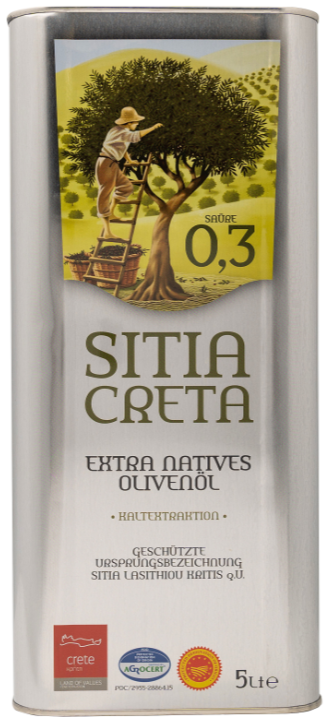

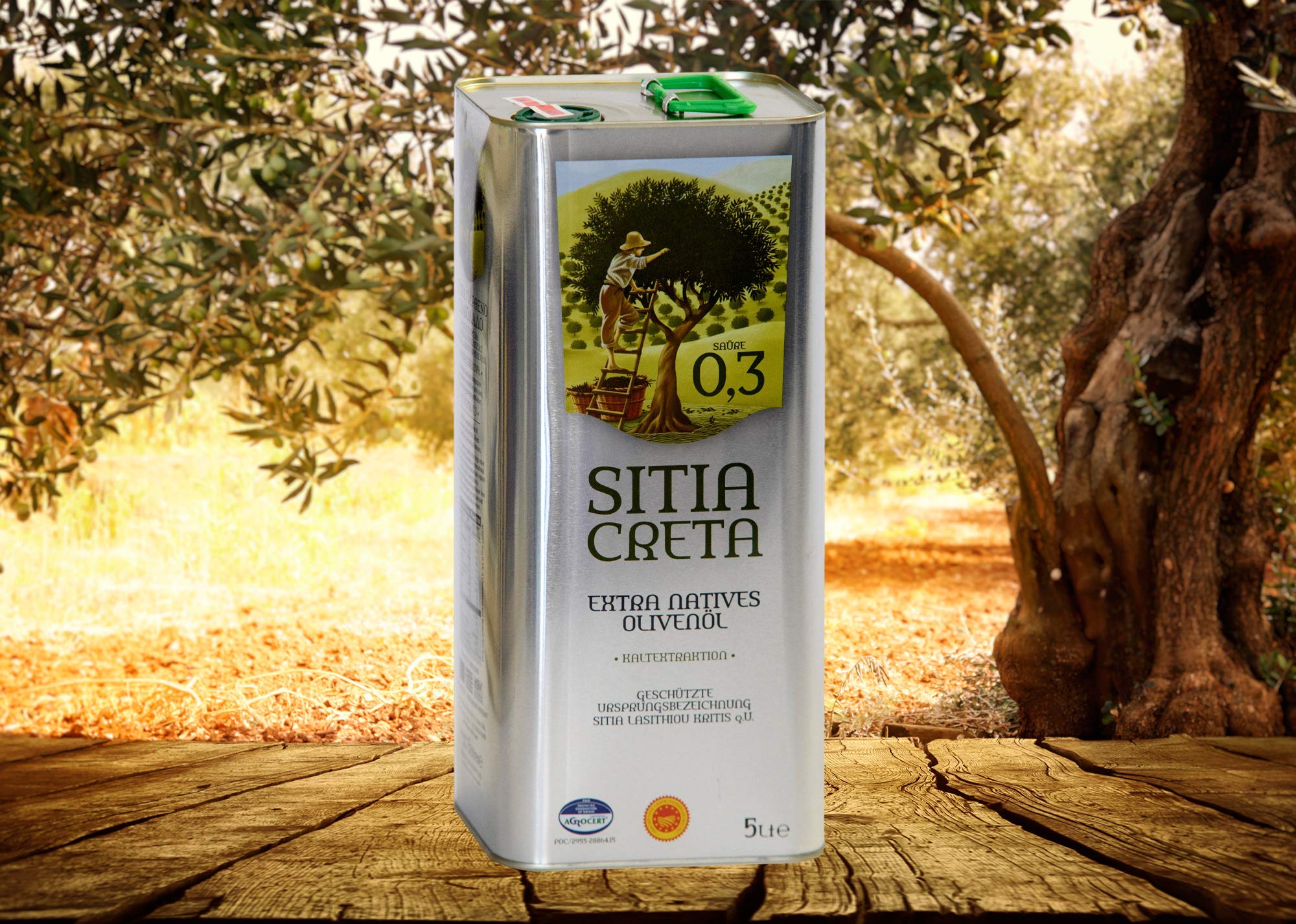
Extra Virgin Olive Oil - 0,3% - Sitía ( silver ) from Crete - Protected Designation of Origin stamp - 5 Liter
799 SEK
Treat your taste buds to the best with Sitia Creta 0.3 extra virgin olive oil! Our olive oil is not only a source of great taste, but also health and quality. With a fresh and fruity flavor that is perfect for both cooking and salad dressings, this 5-liter bottle will be a sustainable choice for your kitchen.
Our Sitia Creta olive oil has been awarded its Protected Designation of Origin (P.D.O.), which is a guarantee of its authenticity and traditional manufacturing process.
- Secure payment by card
- Free shipping from SEK 799!
- Email us, we will respond quickly!
Description
Article no.: 343
Olive oil, extra virgin olive oil SITIA CRETA 0.3, P.D.O. SITIA, 5L, FREE SHIPPING!!!
Best before date: 20280123
Superior category olive oil
cold-pressed olives
from Sitia P.D.O. (Protected Designation of Origin) Sitia Lasithiou Kritis
variety: Koroneiki
0.3 acidity
Content per: 100 ml
Energy 824 kcal
3389 kJ
Fat 100 g
- of which saturated fat 12.8 g
- of which monounsaturated fat 72.1 g
- of which polyunsaturated fat 6.7 g
Carbohydrates 0 g
- of which sugars 0 g
Protein 0 g
Salt 0 g
Acidity 0.39%
Olive cultivation and olive oil production have been part of human history since time immemorial, as evidenced by artifacts and archaeological remains from the earliest civilizations. Olives have been an integral part of life in the eastern Mediterranean since the dawn of civilization. Stone mortars and presses used for extracting olive oil date back to 5000 B.C. Archaeological finds from the Minoan palaces on Crete are fine examples of the role of olive oil in the Cretan or Minoan civilization, which reached its zenith between 2000 and 1450 B.C.
From ancient Egypt through to modern religions, olive oil has been used in religious ceremonies and as an ointment for external use, and you’ll find many references to olives in the Old Testament and other sacred texts. After the Flood, an olive leaf brought by a dove signaled to Noah that the floodwaters had receded. Throughout various civilizations, the olive tree and olive oil have played central roles in the agricultural economies of Mediterranean countries and in their trade with neighboring peoples. The Minoans of Crete were the first civilization to achieve prosperity through olive oil, and Crete remains an important olive-producing region to this day.
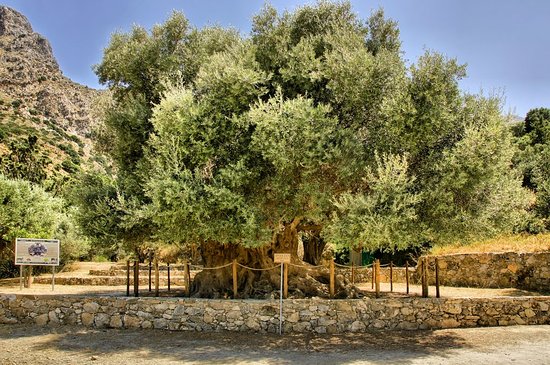
Monumental ancient Minoan olive trees in Azoria, Kavousi, Lasithi, Crete
The production of olive oil has undergone many stages over the years, evolving into what it is today. Stone threshing floors, small mills, manual and later electric presses. Today, olive oil is produced using modern methods. The olives are processed more effectively so that this natural product is produced in accordance with the provisions of European legislation.
The History of Olive Oil in Minoan Crete
Archaeological finds proving that the Minoans used olive oil in their daily lives are found throughout Crete, particularly in the Sitia region of Lasithi. A particularly impressive discovery is the intact olives with their flesh preserved, found at the bottom of a cup submerged in a water cistern in one of the four major Minoan palaces on Crete, the Minoan palace at Kato Zakros, which dates back to 1600 B.C. Finds such as amphorae and large ceramic vessels called “Lini,” which were used for olive oil production, have been discovered in many houses around the Kato Zakros Palace and in Minoan mansions in Palaikastro and Itanos, Sitia.
Ancient stone olive presses have been found on Crete. The one at Vathypetro, Archanes, is believed to be the oldest in Europe. Olive oil was stored in large pithoi, such as those found in the West Magazines of the Minoan Palace of Knossos, with a total estimated capacity of 250,000 kilograms. The Minoans used olive oil in their diet, as a cleaning agent instead of soap, as a base for perfumes and ointments, as medicine, for lighting, and to protect delicate surfaces.
The Benefits of Greek Olive Oil
In Greece today, olive oil is almost sacred. The Greek people are the world’s largest consumers of olive oil per capita: national average consumption ranges from 18 liters to over 30 liters per person; the highest consumption is certainly among the people of Crete, where annual consumption per person averaged 31 liters, according to a 1996 study.
The basic ingredient for sauces in Greek cuisine is olive oil, just as soy sauce is for the Chinese or Worcestershire sauce is for the English. Greek olive oil is, of course, more than just a sauce, but it is the sine qua non (the essential element without which nothing is possible), and without it, Greek cuisine as we know it could not exist. In the English-speaking world, a recipe for a Greek dish typically calls for two tablespoons of oil. The same recipe in a Greek household calls for half a cup. Anywhere in Crete, it calls for a full cup.
To a traveler, an authentic Greek or Cretan dish will seem to be swimming in olive oil. You might say that so much oil provides too many calories and too much fat. But it is actually the fuel for the Greeks, and Greek olive oil—especially the Cretan variety—is healthy food and fuel.
Several studies have shown that a Mediterranean diet—low in saturated fats but rich in monounsaturated fats like olive oil, as well as whole grains, fruits, and vegetables—helps prevent heart disease and even cancer. Another study reported a few years ago in the New England Journal of Medicine found that adherence to a Mediterranean diet in a Greek population significantly reduced mortality risks, particularly the risks of death from heart disease and cancer. The traditional diet evaluated included plenty of olive oil, an abundance of vegetables and fruits, nuts, grains, and moderate consumption of fish and wine. The diet as a whole was considered to provide these benefits, but its content of monounsaturated fat (primarily from olive oil) plays a key role in this protective effect.
It should be noted that the ideal climate of Greece and Crete contributes most favorably to the superiority of its olive oil: it has a richer, fruitier flavor, an intense aroma, and a distinct green color. The blazing sunshine in Greece and its islands produces an abundance of anthocyanins, flavonoids, and phenols—natural plant compounds that combat oxidation caused by the sun’s ultraviolet rays.
The benefits of Greek olive oil have been sufficiently proven. The best way to find out is to incorporate olive oil into your diet.
More about the source text: The source text is required if you want additional information about the translation
Files and media
 | Attached file |